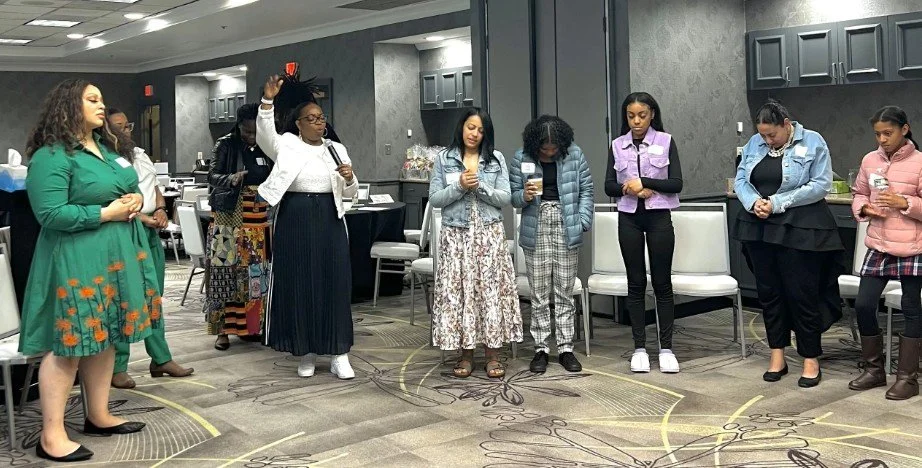
Ripple Effect Workshops
Equipping Ministry Leaders & Believers for Kingdom Service
Ministry Training Curriculum
The following are purpose-built training modules developed by Potter's Wheel Community Services for the modern church. Each module addresses a critical dimension of ministry life and Kingdom advancement — equipping believers, lay leaders, and ordained ministers with the theological grounding, relational skills, and practical tools needed to fulfill their calling with excellence, integrity, and lasting impact. Participation is organized by cohort: some modules are designed specifically for pastors, church leaders, and ministry staff (Ministry Leaders Cohort); others are designed for lay members of the congregation (Lay Members Cohort); and several are open to both. Cohort designations are clearly indicated within each training module.
-
Cohort: Both Ministry Leaders & Lay Members
Discipleship training equips believers to grow from spiritual infancy to maturity in Christ (Matthew 28:19–20; Colossians 1:28). It develops structured pathways — one-on-one mentoring, small group formation, Scripture study, and accountability — that produce reproducing disciples who are capable of investing in others. A church without intentional discipleship produces converts without depth and activity without transformation.
True discipleship is not a program — it is a relationship lived out over time. It requires leaders who are themselves being discipled, who understand the stages of spiritual development, and who are skilled in walking alongside people through the realities of everyday life. The most effective models hold together doctrinal formation and personal life application, shaping both the mind and character of every believer.
A discipleship-centered church is a reproducing church. When every believer is equipped to make disciples, the multiplication effect accelerates Kingdom impact far beyond what any single pastor or program could achieve alone. Discipleship training is not optional — it is the engine of the Great Commission.
-
Cohort: Both Ministry Leaders & Lay Members
Rooted in Acts 1:8 and the Great Commission, evangelism training equips every believer to share the gospel clearly, confidently, and contextually — in neighborhoods, workplaces, and across cultures (Acts 1:8; Matthew 28:19). Participants learn how to craft a personal testimony, present the gospel effectively using time-tested methods, and engage seekers with grace and truth. A church that does not evangelize is not fulfilling its mandate.
Many believers are paralyzed by fear or a sense of inadequacy when it comes to sharing their faith. Effective evangelism training dismantles those barriers by giving participants a clear understanding of the gospel message, confidence in its power (Romans 1:16), and practical tools for everyday gospel conversations. Evangelism is a skill that grows through training and practice — it is not reserved for the spiritually elite or professionally ordained.
In a pluralistic and post-modern culture, evangelism training must also equip believers to engage honest questions with intellectual credibility and personal warmth. The church that trains its members to evangelize well will not only grow numerically — it will cultivate a culture of missional urgency that transforms every sphere of community life it touches.
-
Cohort: Ministry Leaders
Healthy churches grow leaders on purpose (2 Timothy 2:2; Ephesians 4:11–12). This training identifies, equips, and releases emerging leaders at every level — from small group facilitators to elders and senior pastors. Topics include servant leadership principles, vision casting, conflict resolution, team building, and the integration of biblical character with organizational competency. Every church is only as strong as the leaders it intentionally develops.
Paul's charge to Timothy — to entrust what he had received to faithful people who would be able to teach others also (2 Timothy 2:2) — establishes a multi-generational leadership pipeline. Leadership development is not merely a management strategy; it is a biblical mandate. The next generation of Kingdom builders must be raised up with intentionality, accountability, and genuine investment from those who lead them.
This training addresses not only skills and strategy, but also the character, emotional health, and spiritual depth that sustainable leadership demands. Leaders who are technically gifted but spiritually shallow will eventually fracture the communities they are called to serve. The best leadership development integrates the inner life of the leader with the outward expression of influence in the church and community.
-
Cohort: Both Ministry Leaders & Lay Members
Scripture is unambiguous about the call to forgive: "Be kind and compassionate to one another, forgiving each other, just as in Christ God forgave you" (Ephesians 4:31–32; see also Matthew 18:21–22; Colossians 3:13). The Ministry of Forgiveness Training explores the theology and practice of forgiveness — why God commands it, what it actually means to forgive, and how unforgiveness quietly poisons individuals, families, and entire congregations from the inside out.
Unforgiveness is one of the most pervasive and under addressed sources of dysfunction in the body of Christ. It manifests as bitterness, chronic conflict, leadership fatigue, and a loss of spiritual vitality that no program or personnel change can fix. This training equips ministers and lay leaders to recognize the signs of unforgiveness and to lead others through the process of genuine, Christ-centered forgiveness — not as a feeling but as an act of obedient faith.
Participants leave equipped with practical tools for creating cultures of grace, reconciliation, and healing. Whether navigating interpersonal conflict, congregational fracture, or personal betrayal, this training provides the biblical framework and relational skills to walk people from offense to freedom — and from fracture to restored community in Christ.
-
Cohort: Two Cohorts — (1) Ministry Leaders Cohort | (2) Lay Members Cohort
Overview
Foundational Biblical Care is a comprehensive training module equipping both ministry leaders and lay members to offer biblically grounded, pastorally sensitive care to those experiencing emotional, relational, spiritual, and life crisis. Drawing on the sufficiency of God's Word for all matters of life and godliness (2 Peter 1:3–4; 2 Timothy 3:16–17), participants are trained to understand the nature of human need through a biblical anthropology — integrating the doctrine of man, the reality of sin, the power of the gospel, and the ministry of the Holy Spirit into every dimension of care.
Ministry Leaders Cohort
Designed for pastors, elders, counselors, and chaplains in formal ministry who provide ongoing care and counsel. This cohort goes deeper into biblical counseling theology, case-based learning, crisis intervention frameworks, and the supervision of lay care teams. Leaders leave equipped not only to provide care themselves but to build and deploy care ministries that multiply pastoral reach far beyond what any single pastor could accomplish alone.
Lay Members Cohort
Accessible and practically oriented, this cohort is grounded in the conviction that every member of the body of Christ is called to "bear one another's burdens" (Galatians 6:2) and to speak truth in love (Ephesians 4:15). Participants leave with a working toolkit of listening skills, gospel-centered responses, appropriate boundaries, and referral pathways — equipped to be instruments of Christ's healing presence in the lives of those around them.
-
Cohort: Ministry Leaders
Pastoral ministry is one of the most demanding callings in the body of Christ. Pastors and ministry leaders regularly carry burdens invisible to their congregations — burnout, grief, isolation, compassion fatigue, and the relentless weight of shepherding others through crisis. This training is designed to support and restore those who serve, rooted in Paul's testimony: "We are hard pressed on every side, but not crushed; perplexed, but not in despair" (2 Corinthians 4:8–9).
Participants discover that receiving care is not a sign of weakness — it is a mark of wisdom and spiritual maturity. The training creates a safe environment for ministry leaders to honestly name what they are carrying, learn how to build healthy support systems, and identify the personal rhythms and boundaries that make long-term ministry sustainable rather than sacrificial to the point of collapse.
Through guided reflection, peer dialogue, and practical tools drawn from Scripture and the best of pastoral care literature, participants are renewed in their sense of calling, reconnected to the God who carries them, and equipped to continue in ministry with restored strength, clearer vision, and sustainable rhythms that honor both their vocation and their humanity.
-
Cohort: Both Ministry Leaders & Lay Members
This facilitated dialogue session creates a safe, structured space for ministry leaders and lay members to explore the theology and practice of presence ministry — the sacred art of being with people in their darkest moments (Job 2:13; Romans 12:15). Participants engage in guided conversations around grief, trauma, loss, and spiritual crisis, learning how to simply "show up" with compassion and patient solidarity — without reaching for formulas, quick answers, or well-intentioned platitudes that unintentionally minimize pain.
The session draws on the example of Job's friends — whose greatest ministry was their silent presence before they opened their mouths — and on the New Testament call to "weep with those who weep" (Romans 12:15). In an age of noise and productivity, the ministry of presence is a countercultural and profoundly Christlike posture. This dialogue equips participants to recover it as a core ministry competency available to every believer, not just ordained pastors.
The session also addresses the restoration of leaders and believers who have themselves experienced deep personal pain, failure, or disillusionment. Participants explore what it means to be simultaneously a wounded healer and a faithful minister — and how the church can become a community where the broken are not merely tolerated but genuinely restored to wholeness, dignity, and renewed purpose in Christ.
-
Cohort: Two Cohorts — (1) Ministry Leaders Cohort | (2) Both Ministry Leaders & Lay Members
This training track is offered in two distinct cohorts, each tailored to a specific audience and calling — together forming a comprehensive approach to missional identity for every level of church life.
Cohort 1 — Helping Pastors Develop Missional Ministry (Ministry Leaders)
This cohort equips senior pastors and church leaders to reorient their congregations around a missional identity — moving the church from an attractional model to an incarnational one. Rooted in Jesus's own sending framework — "As the Father has sent me, I am sending you" (John 20:21) — participants develop practical strategies for community exegesis, deploying members into their natural spheres of influence, and building Kingdom partnerships for holistic community impact.
Pastors leave with a renewed vision of the church as a sent community, not merely a gathered one — with concrete next steps for reshaping their congregation's culture, programming, and partnerships around a missional identity that extends the reach of the gospel into every corner of their context and beyond.
Cohort 2 — Discerning My Call to Missions (Both Ministry Leaders & Lay Members)
Designed for individuals who sense a call to domestic or international missions, this cohort provides theological foundations, personal discernment exercises, and practical frameworks for answering the question: "Has God called me?" Drawing on Romans 10:14–15 and Acts 13:1–3, participants examine their spiritual gifts, passions, and life experiences through a missional lens.
Leaders from Potter's Wheel Community Services walk alongside participants as mentors, sharing firsthand experience across diverse ministry contexts. Participants discern whether their calling is short-term or long-term, local or cross-cultural — and leave with a clear personal mission statement and a mapped pathway for their next steps of obedience.
-
Cohort: Both Ministry Leaders & Lay Members
This survey course provides a comprehensive overview of the Old Testament — its narrative arc, major themes, literary genres, and theological contributions to the whole of Scripture. Beginning with creation and the covenants of Genesis, moving through the Law, the historical books, the wisdom literature, and the prophets, participants gain a coherent and confident understanding of how the Old Testament forms the essential foundation for everything the New Testament reveals. Far from being a collection of disconnected stories, the Old Testament is a unified, Spirit-breathed narrative that consistently points forward to the person and work of Jesus Christ (Luke 24:27, 44).
This course equips both ministry leaders and lay members to read, teach, and apply the Old Testament with theological accuracy and personal relevance. Participants leave with a clear grasp of the storyline of redemption, the character of God as revealed through the history of His people, and the ability to interpret Old Testament texts faithfully in light of the full canon of Scripture.
-
Cohort: Both Ministry Leaders & Lay Members
The New Testament Survey course offers a thorough and accessible examination of all twenty-seven books of the New Testament — from the four Gospels and Acts, through the Pauline and General Epistles, to the Revelation of John. Participants explore the historical and cultural context of each book, the identity and purpose of each author, and the theological themes that run through the entire New Testament corpus. Special attention is given to the life, teaching, death, and resurrection of Jesus Christ as the center and climax of all biblical revelation (Colossians 1:15–20; Hebrews 1:1–3).
This course equips both ministry leaders and lay members to engage the New Testament with depth, coherence, and confidence — moving beyond surface-level familiarity to a rich understanding of the apostolic witness and its implications for the life of the church today. Participants will be better prepared to preach, teach, study, and live the New Testament as an integrated whole, rightly handling the word of truth (2 Timothy 2:15).
-
Cohort: Two Cohorts — (1) Ministry Leaders Cohort | (2) Lay Members Cohort
Overview
Biblical hermeneutics is the science and art of interpreting Scripture — one of the most essential skills in the entire theological toolkit. This training equips participants to move beyond surface-level reading to a rigorous, faithful, and Spirit-guided engagement with the biblical text. Rooted in the conviction that Scripture interprets Scripture, and that every text must be read in its historical, literary, grammatical, and canonical context, this module gives participants the tools to understand what the original author intended and how that meaning applies to the contemporary reader (Nehemiah 8:8; 2 Timothy 2:15).
Ministry Leaders Cohort
This cohort goes deeper into exegetical methodology — original language considerations, genre analysis (narrative, poetry, prophecy, epistle, apocalyptic), the use of Bible study tools, and sermon preparation rooted in faithful textual interpretation. Leaders leave equipped to handle the Word with accuracy and authority, building congregations whose faith is grounded in the text rather than personal opinion or cultural preference.
Lay Members Cohort
Designed to be accessible and immediately practical, this cohort equips everyday believers to open their Bibles with confidence, ask the right interpretive questions, and apply the text faithfully to their lives and contexts. Participants learn to identify common interpretive pitfalls — such as reading texts out of context or imposing contemporary assumptions onto ancient texts — and to develop personal Bible study habits that are both intellectually honest and spiritually nourishing.
-
Cohort: Two Cohorts — (1) Ministry Leaders Cohort | (2) Lay Members Cohort
Overview
Systematic theology is the discipline of organizing the whole of biblical teaching into coherent, interconnected doctrinal categories — from the doctrine of Scripture through the doctrine of Last Things. This training walks participants through the major loci of Christian theology in a structured, cumulative way, helping them see not only what the Bible teaches on each topic but how the doctrines relate to and reinforce one another. A believer who understands systematic theology has a mental framework for their entire faith (Romans 12:2; Colossians 2:6–7).
Ministry Leaders Cohort
This cohort is designed for pastors, teachers, and leaders who must preach and teach the full counsel of God with accuracy and coherence. Participants engage each doctrine at greater depth — examining primary texts, wrestling with theological tensions, and developing the ability to teach doctrinal content in a way that is both intellectually rigorous and pastorally warm. Leaders leave better equipped to preach theologically rich sermons, disciple their congregations doctrinally, and respond to theological error with clarity and grace.
Lay Members Cohort
The lay cohort makes systematic theology accessible to every believer — presenting the great doctrines of the faith in plain language, with practical implications for daily Christian living. Participants discover that theology is not dry academia but the living, breathing framework for knowing God, understanding themselves, and engaging the world with wisdom. This cohort produces theologically literate congregants who can articulate what they believe and why.
-
Cohort: Two Cohorts — (1) Ministry Leaders Cohort | (2) Lay Members Cohort
Overview
Christian ethics is the application of biblical truth to the moral decisions, cultural challenges, and social questions that believers face in every generation. This training equips participants to think Christianly — to approach every dimension of life (family, work, politics, sexuality, technology, race, economics, and culture) through the lens of a thoroughly biblical worldview. The goal is not merely to know the right answers but to develop a sanctified moral imagination rooted in the character of God, the teachings of Christ, and the whole counsel of Scripture (Micah 6:8; Romans 12:1–2; Colossians 3:17).
Ministry Leaders Cohort
This cohort engages the most pressing ethical issues facing the contemporary church — bioethics, sexual ethics, social justice, political theology, racial reconciliation, and the church's relationship to culture. Leaders leave equipped to preach and pastor through controversial topics with biblical fidelity, theological clarity, pastoral wisdom, and courageous grace. They are also equipped to help their congregations develop moral reasoning frameworks rather than simply providing answers.
Lay Members Cohort
This cohort equips everyday believers to navigate the complex moral landscape of 21st-century life — in their workplaces, families, social media, civic engagement, and personal decision-making — as people who think from Scripture outward rather than from culture inward. Participants develop the capacity to articulate a Christian position on difficult questions with both conviction and compassion, becoming salt and light in every sphere of influence God has entrusted to them (Matthew 5:13–16).
-
Cohort: Both Ministry Leaders & Lay Members
The interior life of the believer is the foundation of all fruitful ministry and faithful living. This training module is dedicated to the cultivation of the spiritual disciplines — the God-ordained practices by which believers keep themselves in the presence of God, train themselves in godliness, and create the inner conditions in which the Holy Spirit does His transforming work (1 Timothy 4:7; Luke 18:1; Psalm 46:10). The disciplines include prayer, fasting, Scripture meditation, solitude, silence, worship, corporate gathering, and service — each practiced not as a means of earning God's favor but as a means of receiving it.
The training gives special attention to prayer as the foundational discipline of the Christian life — teaching participants how to develop a personal and corporate prayer life rooted in Scripture, saturated in adoration, honest in confession, persistent in petition, and surrendered in intercession. Worship is explored in both its private and corporate dimensions, helping participants understand that genuine worship is not confined to a Sunday service but encompasses the totality of a life offered to God (Romans 12:1). Leaders in the Ministry Leaders track also receive training in leading corporate worship and prayer that is theologically grounded and spiritually alive.
Spiritual disciplines training ultimately produces believers who are not merely busy for God but deeply formed by God — leaders and lay members whose public ministry flows from a rich private communion with Christ. In an age of distraction, noise, and relentless activity, the church desperately needs men and women who have learned to be still, to listen, to pray without ceasing, and to lead from a place of genuine encounter with the living God (1 Thessalonians 5:17; Matthew 6:6).
-
Cohort: Both Ministry Leaders & Lay Members
Jesus spoke more about money and possessions than almost any other subject — because He understood that the management of material resources is a direct reflection of the condition of the heart (Matthew 6:24; Luke 16:11). Biblical stewardship training teaches believers to handle money as God's managers — budgeting wisely, giving generously, eliminating debt, building financial margin for Kingdom purposes, and holding material things with an open hand (Malachi 3:10; Proverbs 21:5; 2 Corinthians 9:6–7). Financial bondage is one of the leading causes of dysfunction in families and churches, and financial freedom is a powerful witness to the sufficiency of God.
Ministry Leaders Cohort
This cohort extends stewardship training to institutional and organizational financial integrity — transparent accounting practices, sound ministry budgeting, compliance with grant requirements, donor relations, and the cultivation of a culture of generosity and accountability within the congregation. Leaders who handle money with integrity build trust with donors, partners, and communities, multiplying their capacity to serve and advance Kingdom work. Financial mismanagement in ministry is not merely a practical failure — it is a testimony failure.
Lay Members Cohort
The lay cohort focuses on personal financial discipleship — equipping everyday believers to manage their households as stewards of God's resources. Participants receive practical tools for budgeting, debt reduction, generosity planning, and long-term financial margin — rooted in the conviction that faithful stewardship is an act of worship, a form of discipleship, and a pathway to greater Kingdom impact in every season of life.
These training modules are not academic exercises — they are Kingdom investments. Under the co-founding leadership of Reverend Brian Mitchell and Natasha Mitchell, Potter's Wheel Community Services is committed to equipping both ministry leaders and lay members with the theological formation, relational skills, and practical tools to fulfill the Great Commission with excellence and integrity — wherever God has called, to every people He has prepared, and to the ends of the earth.